

On 6 October 2026, Saudi Arabia's Ministry of Environment, Water and Agriculture (MEWA) reported egg production of more than 9 billion eggs in 2026, and self-sufficiency of 100% in table eggs [1]. With the home market now supplied by local flocks, every egg lost to a poor shell is a loss the local industry carries itself.
Those losses are not small. One study cites about 10–15% of eggs lost to eggshell quality problems before or during collection [2]. Cracked eggs are a food safety issue as well as a financial one, because bacteria can get in through the shell [3]. Shell problems also become more common as hens age [3].
Shell quality depends on genetics, health, housing and handling as well as feed. This article covers the feed side: calcium, vitamin D3 and three trace minerals.
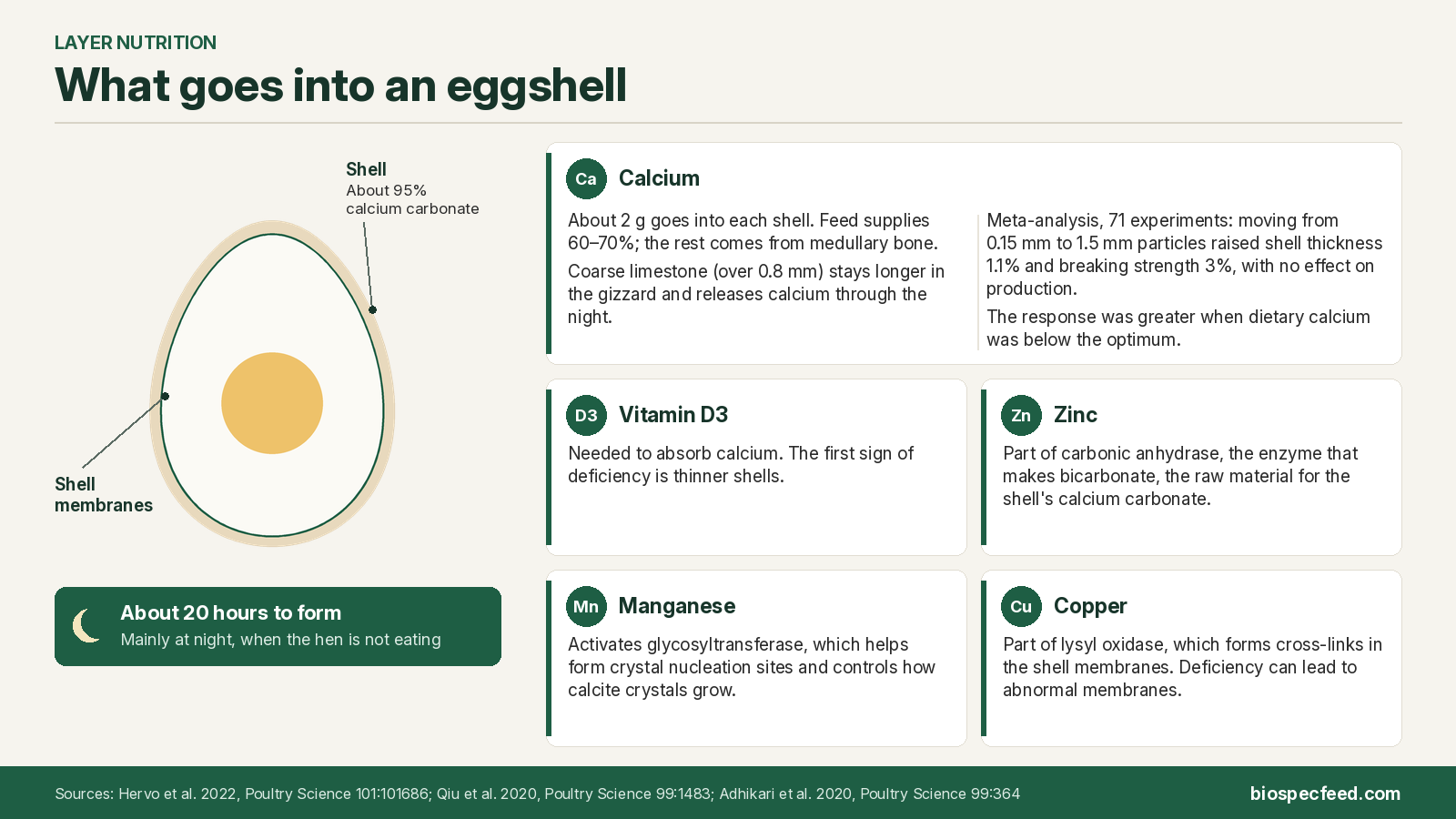
A shell is about 95% calcium carbonate [4]. The hen puts about 2 g of calcium into each shell. The diet supplies 60–70% of that, and the rest comes from a reserve in the bones called medullary bone [4].
Timing matters. Shell formation takes about 20 hours and happens mainly at night, when the hen is not eating [4]. So the question is not only how much calcium is in the feed, but whether it is still available in the gut during the night.
The shell also has an organic framework, and three trace minerals help build it [2]:
The 1994 NRC requirement for white-egg layers eating 100 g of feed a day is 3.25% calcium, or 3.25 g per hen per day. A footnote adds that the requirement may be higher for maximum shell thickness [6].
Particle size is where many feeds differ. A meta-analysis of 71 experiments published between 1971 and 2019 found that coarse limestone stays longer in the gizzard and is dissolved more completely there than fine limestone [4]. Going from 0.15 mm to 1.5 mm particles increased shell thickness by 1.1% and shell breaking strength by 3%, with no effect on production performance [4]. The authors explain this by coarse particles releasing calcium through the night, when the shell is being formed [4].
"Coarse" in this work means particles larger than 0.8 mm. There is no consensus on the best coarse-to-fine ratio, though 75% coarse and 25% fine is often used for older hens [4]. The response to coarse limestone was greater when dietary calcium was below the optimum [4].
Vitamin D is needed to absorb calcium and phosphorus [7]. When hens are fed a diet short of vitamin D, the first sign is thinner eggshells [7]. In the body it is converted to an active form that stimulates calcium absorption in the gut. As hens age, levels of that active form fall and calcium absorption declines [4].
NRC lists 300 IU of vitamin D3 per kg of diet at 100 g of feed a day [6]. A metabolite, 25-hydroxyvitamin D3, is also used commercially. Whether it gives better results than vitamin D3 is still debated [7].
NRC 1994 lists 20 mg/kg manganese and 35 mg/kg zinc at 100 g of feed a day. It gives no copper figure for laying hens; the table shows a question mark [6]. These are 1994 estimates for Leghorn-type hens, not commercial specifications.
Two trials show why the levels used in practice matter:
Hot climates make this harder. Panting in heat-stressed birds upsets the acid-base balance of the blood and leads to respiratory alkalosis, and heat stress lowers egg quality [5]. For Gulf layer flocks, the summer months are when shell specifications matter most.
| Item | What to ask for | Why |
|---|---|---|
| Limestone | Particle-size distribution (sieve analysis) for each lot, including the share above 0.8 mm, plus calcium content | Particle size affects how much calcium is available overnight [4] |
| Layer feed by phase | The coarse-to-fine limestone ratio used for older flocks | Older hens absorb calcium less well [4] |
| Vitamin D3 | Declared and analysed vitamin D3 in the premix, plus expiry date | Deficiency first shows as thinner shells [7] |
| Trace minerals | Analysed manganese, zinc and copper in the premix compared with the label, and total levels in the finished feed | The base diet already contributes some, as the trial above shows [8] |
| Records | Batch numbers and a certificate of analysis for each delivery | SFDA requires batch-level records of incoming materials [9] |
When shell quality drops, these records let you rule the feed in or out quickly, before looking at health, housing or handling.
If you would like to talk through layer feed specifications, contact BioSpec.

BioSpec Feeds was founded to develop an innovative collaboration between leading animal feed manufacturers and cutting edge academic insight providing sustainable solutions to integrators and farmers by supporting feed supplementation solutions for improved animal health, welfare, and production efficiency. Focusing on natural, sustainable, scientifically proven formulae that support the health and growth of livestock animals.
Copyright ©2021 BioSpec feeds | All Rights Reserved.
Arrowsmith Court, Station Approach, Broadstone, Dorset, BH18 8AT United Kingdom
