

Egypt's poultry sector produced 1.6 billion commercial broilers in 2025, plus 320 million birds from rural production. Together they covered 97% of domestic broiler demand. The sector also produced 16 billion table eggs, or 140 per person. Before 2023 the figures were 1.4 billion birds and 14 billion eggs.1
USDA's Cairo office calls the poultry industry "the primary driver of feed and corn demand".1 Large integrated companies are investing in new chick, broiler and egg projects, and the government is similarly expanding licences for poultry and feed projects.1,2
For compound mills, that growth comes with a feed bill that is largely priced abroad.
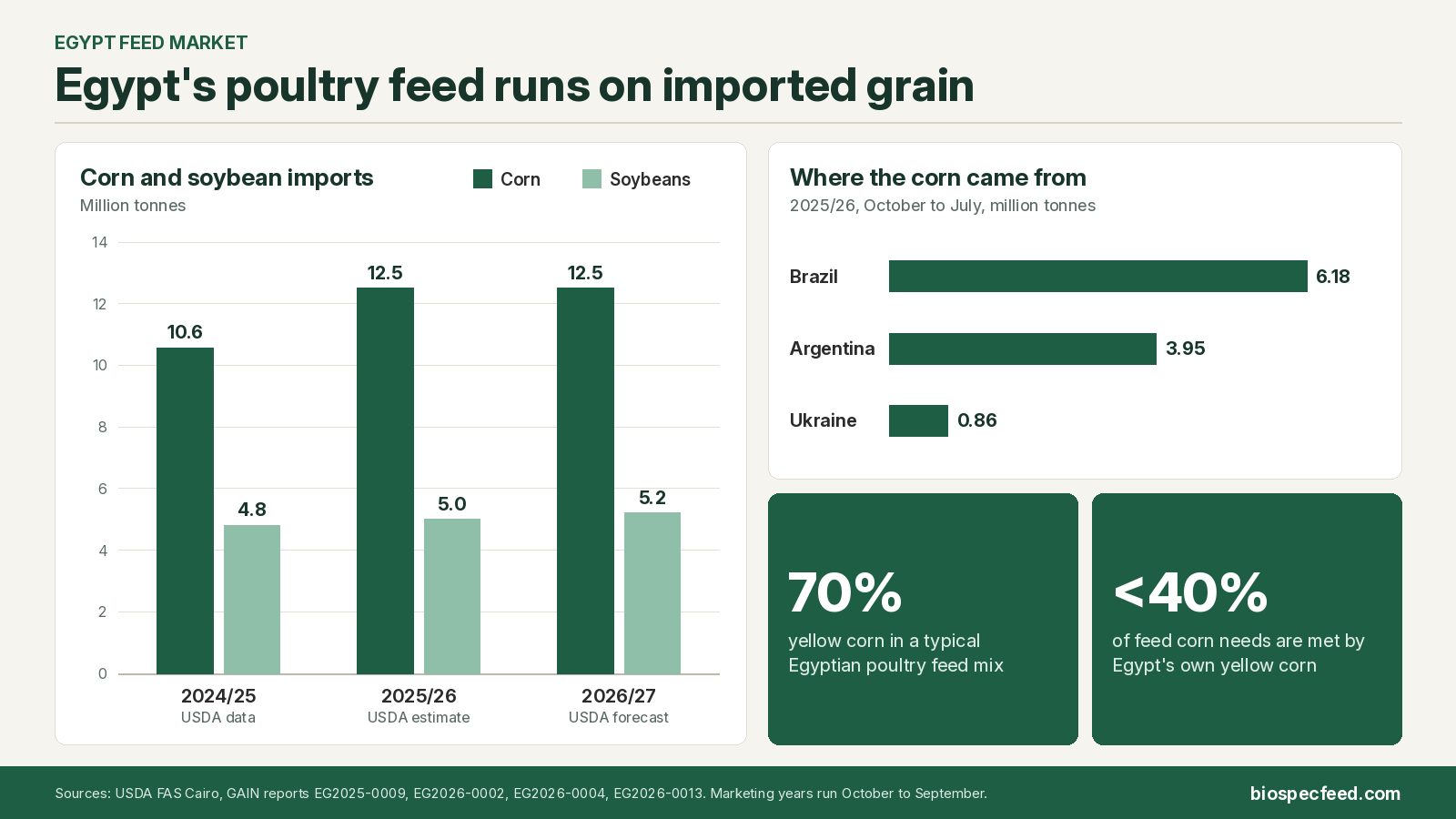
USDA describes the typical Egyptian poultry feed mix as 70% yellow corn and 19.4% soybean meal, plus wheat bran, concentrates, minerals and vitamins.3 Currently, both main ingredients depend on imports:
Because most grain is bought in dollars, the exchange rate matters as much as world prices. Periods of currency adjustment between 2022 and 2024 raised the local cost of imported feed.5
Since the Central Bank of Egypt moved to a market-set exchange rate in March 2024,6 foreign currency has been much easier to obtain. USDA links this to larger feed imports and lower feed production costs,1,2 and the IMF reports no backlog of currency requests at banks.7
For purchasing teams, access to dollars is now far less of a constraint, while the price in pounds still moves with the exchange rate.
Over the five years to 2024/25, Egypt's top corn suppliers were Brazil (19.9 million tons), Ukraine (11.7) and Argentina (9.5).1 The mix is shifting. In 2025/26 (October–July), Brazil supplied 6.18 million tons, Argentina 3.95 and Ukraine 0.86.2 USDA points to renewed Ukrainian shipping setbacks, including port strikes and costlier rerouting, and expects more corn from the United States and South America.2 For soybeans, about 72% of Egypt's imports since 2020/21 came from the United States.4
A change of origin brings a different harvest, a longer voyage and a different storage history. BioSpec's guide to imported feed grains, storage and mycotoxins covers what is commonly checked at intake and in the silo.
An Egyptian study followed 186,300 broilers over 18 cycles between April and September 2024.8 Birds in open houses had 15.96% mortality, compared with 5.46% in closed, climate-controlled houses. Heat-attributed mortality was 4.4% against 0.23%. Feed conversion ratios averaged 1.93 in open houses compared with 1.65 in closed environments, meaning 17% greater feed consumption for each kilogram of gain. Feed cost 91.04 EGP per bird in open houses, out of a total cost of 138.79 EGP, or about two thirds.8
Heat stress lowers feed intake while raising feed conversion ratios. Birds need to drink much more water to cope.9 So in hot months, each kilogram of meat costs more feed.
Alongside housing and ventilation, nutrition is one of the tools studied. Betaine acts as an osmolyte and a methyl donor, and under heat stress it helps cells hold water.9 Studies have reported better feed intake and production in heat-stressed broilers and layers given betaine.9 The antioxidant vitamins C and E are also widely studied, and have been reported to improve antioxidant status and heat tolerance in broilers.10 Results vary between studies, and reviews describe these measures as partly offsetting the effects of heat, not removing them.10
Additives do not change the price of corn, but some help protect each ton or make it go further:
Regulators are active too. In 2025 the Ministry of Agriculture approved 8,247 registrations of feed mixtures, additives and concentrates: 5,395 local and 2,852 imported. It ran more than 250 surprise inspection campaigns and seized 187 tons of non-compliant feed.13 It also carried out mixing-homogeneity tests at 497 feed factories with 1,104 production lines.14
| Area | Common practice | Why it matters |
|---|---|---|
| Formula exposure | Tracking the imported share of each formula, mainly corn and soybean meal | Corn and meal make up about 90% of a typical Egyptian poultry mix3 |
| Origin | Recording origin and vessel for each lot, with a certificate of analysis | Longer shipping journeys as corn origins have shifted away from Ukraine2 |
| Intake and storage | Testing moisture, temperature and mycotoxins at intake | Origin, voyage and storage all affect mould risk (see the storage guide) |
| Mycotoxin binders | Adding clay-based binders when aflatoxin risk is high | Clay binders are among the most widely used, mainly against aflatoxins11 |
| Phytase | Checking a supplier's matrix values against in-house analysis | Matrix values drive the cost saving12 |
| Summer | Summer formulas and water plans, with vitamins or betaine where nutritionists see a need | Heat raises feed conversion ratio and mortality8,9 |
| Registration | Confirming Ministry registration for every additive purchased | 2,852 imported registrations were approved in 202513 |
| Mixing | In-house mixer homogeneity tests | The Ministry tests homogeneity before licensing14 |
When most of the feed bill is imported, every ton has to perform. BioSpec supplies compound mills with mycotoxin binders, vitamin, mineral and amino acid supplements, pellet binders and antioxidants, and its BSF ImmuGrow blends, ImmuGrow L for drinking water and ImmuGrow P for feed, which combine organic acids and their salts, plant extracts, essential oils and betaine.
See the additives for compound mills or talk to us about your mill.

BioSpec Feeds was founded to develop an innovative collaboration between leading animal feed manufacturers and cutting edge academic insight providing sustainable solutions to integrators and farmers by supporting feed supplementation solutions for improved animal health, welfare, and production efficiency. Focusing on natural, sustainable, scientifically proven formulae that support the health and growth of livestock animals.
Copyright ©2021 BioSpec feeds | All Rights Reserved.
Arrowsmith Court, Station Approach, Broadstone, Dorset, BH18 8AT United Kingdom
