

Morocco is Africa's third-largest poultry producer, behind Egypt and South Africa. According to the poultry federation FISA, the sector produced 654,000 tonnes of chicken and 174,000 tonnes of turkey in 2025, along with 7.06 billion table eggs. Poultry meat consumption reached 23.6 kg per person, up from 20.9 kg a year earlier.1
Feed is the base of that growth. FISA puts poultry feed production at 3.3 million tonnes in 2023, up 10% on 2022.2 Poultry accounts for 76% of all compound feed made in Morocco.3 Feed inputs, mainly corn, soybean and other grains, make up 60–70% of poultry production costs.1
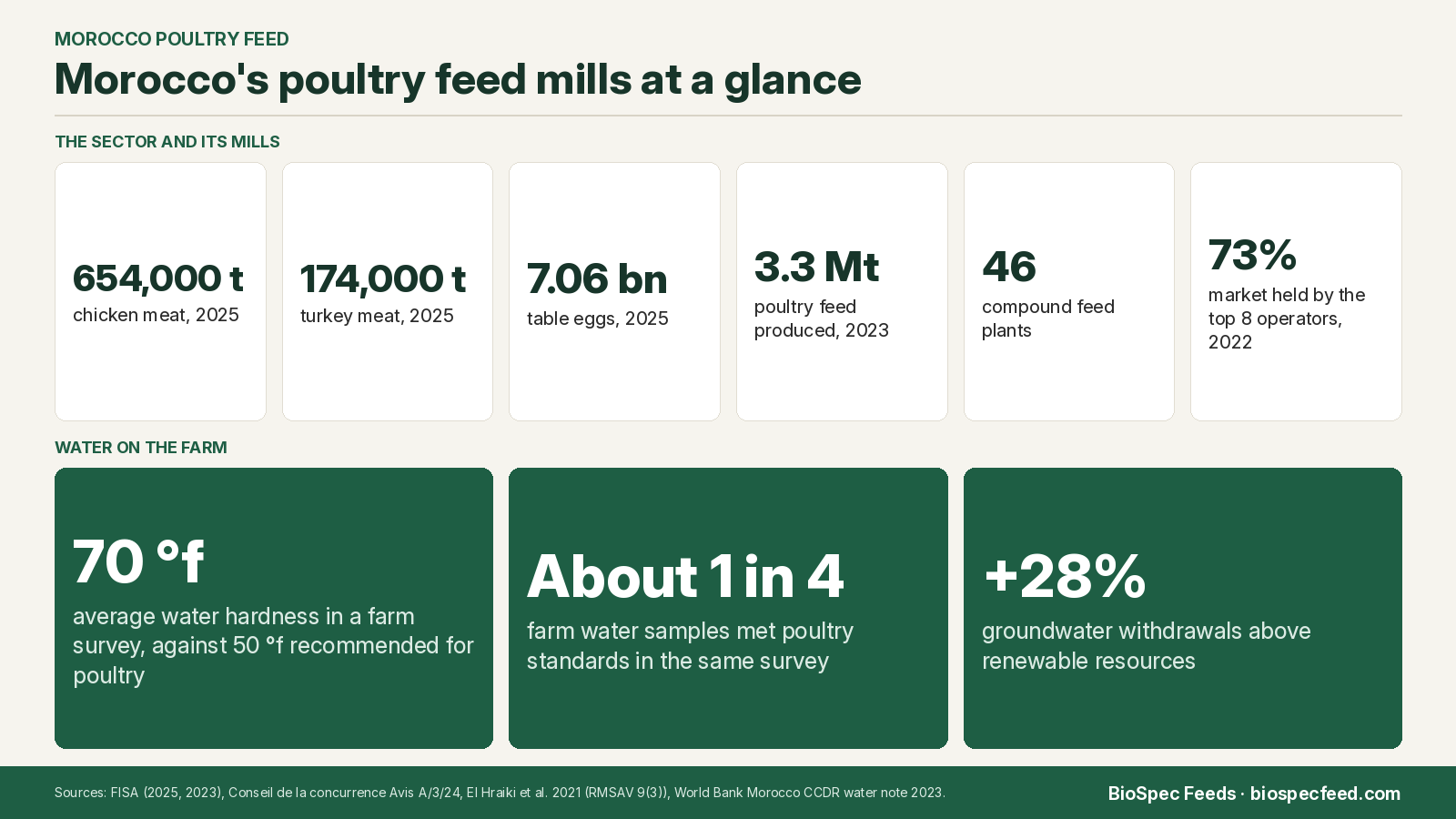
Morocco's Competition Council reviewed the compound feed market in 2024. It counted 46 compound feed plants, according to the manufacturers' association AFAC, with half of them on the Casablanca–Kénitra axis, close to ports and poultry farms. The eight largest operators held 73% of the market by volume in 2022, and two vertically integrated groups held close to half between them.3 The Council did not name the operators, and the sector ran below 60% of its installed capacity.3
Several of the leading mills describe their own scale publicly:
Integration is a common thread. The largest producers own breeders, hatcheries, processing plants and retail outlets as well as feed mills.3,5
Imported grain and price swings. Morocco became a net importer of corn, with domestic production close to zero.3 Corn imports were about 2.6 million tonnes in 2025, led by Brazil, with Argentina and the United States the other main origins.8 Cereals, mainly corn, make up at least half of a standard compound feed, and oilseed meals about 25% by volume but close to half by value. The Council found that poultry feed prices tracked the corn price with a 94% correlation.3
Drought. Seven consecutive years of drought cut domestic cereal yields and exposed producers to world price swings.1 Rain returned in 2025–26: the Agriculture Minister projected a 9 million tonne cereal harvest, more than double the previous season.1 USDA expects better domestic crops to reduce wheat and barley imports.9 Corn, however, remains imported.
Mycotoxins and raw material quality. The Council notes that changes in the type or origin of raw materials can affect feed quality, and that moulds and mycotoxins can harm animal health. It reports that hatchery feeds use more additives and steam treatment to manage mycotoxin risk for breeders. It also records feed conversion ratios above 2 in Morocco, against 1.4–1.9 in Europe.3
Heat stress. Heat lowers feed intake, raises feed conversion and increases water demand.10 Betaine, an osmolyte that helps cells hold water, and the antioxidant vitamins C and E are widely studied in heat-stressed birds. Reviews describe them as partly offsetting the effects of heat rather than removing them.10,11
Water quality. Industry contacts in Morocco also raise drinking water as a production issue, and published farm surveys point the same way. In 150 samples from poultry farms in the Marrakech, El Kelaa des Sraghna, Chtouka-Aït Baha and Tiznit regions, average hardness was 70 °f, above the 50 °f recommended for poultry. Sodium and chloride were high, and only a quarter of samples met poultry standards. Hard water also reduced the solubility of several veterinary medicines given through the drinking water.14 On turkey farms in Khemisset, every sample taken at the water-line inlet failed microbiological standards.15 Supply adds pressure: groundwater withdrawals exceed renewable resources by about 28%, and the national water plan looks to seawater desalination for nearly 1 billion m³ a year by 2050.16 Salt content matters to the bird. In a trial under hot, arid conditions, water intake rose with dissolved solids, and weight gain and feed efficiency fell at the highest level tested, 3,448 ppm.17 Heat compounds the effect, because birds drink more to cool themselves, and electrolytes are among the measures studied for heat-stressed flocks.10 Producers commonly respond with regular water testing, water-line cleaning and electrolyte support in hot periods.
Antibiotic reduction. Morocco prohibits the unauthorised use of antibiotics, including as growth promoters, and monitors the quantities of antimicrobials used in livestock.12 That shifts attention to gut health, feed hygiene and nutrition.
BioSpec supplies additives to compound mills and producers. It does not make compound feed. The BSF 2X BindAway range of mycotoxin binders is based on aluminosilicates with broad-spectrum adsorption capacity. BSF ImmuGrow L (drinking water) and ImmuGrow P (feed) combine organic acids and their salts, plant extracts, essential oils and betaine. For the water line, BSF Electrolyte P, a water-soluble powder, and BSF Electrolyte L, a mixture of electrolytes in liquid form, stabilise the hydric and electrolytic balance, and BSF DrinkSupport, a mixture of organic acids and copper, controls the development of microorganisms in drinking water and helps prevent biofilm in water lines. BioSpec's vitamin, mineral and amino acid supplements complete the range.
See the additives for compound mills or talk to us about your mill.

BioSpec Feeds was founded to develop an innovative collaboration between leading animal feed manufacturers and cutting edge academic insight providing sustainable solutions to integrators and farmers by supporting feed supplementation solutions for improved animal health, welfare, and production efficiency. Focusing on natural, sustainable, scientifically proven formulae that support the health and growth of livestock animals.
Copyright ©2021 BioSpec feeds | All Rights Reserved.
Arrowsmith Court, Station Approach, Broadstone, Dorset, BH18 8AT United Kingdom
